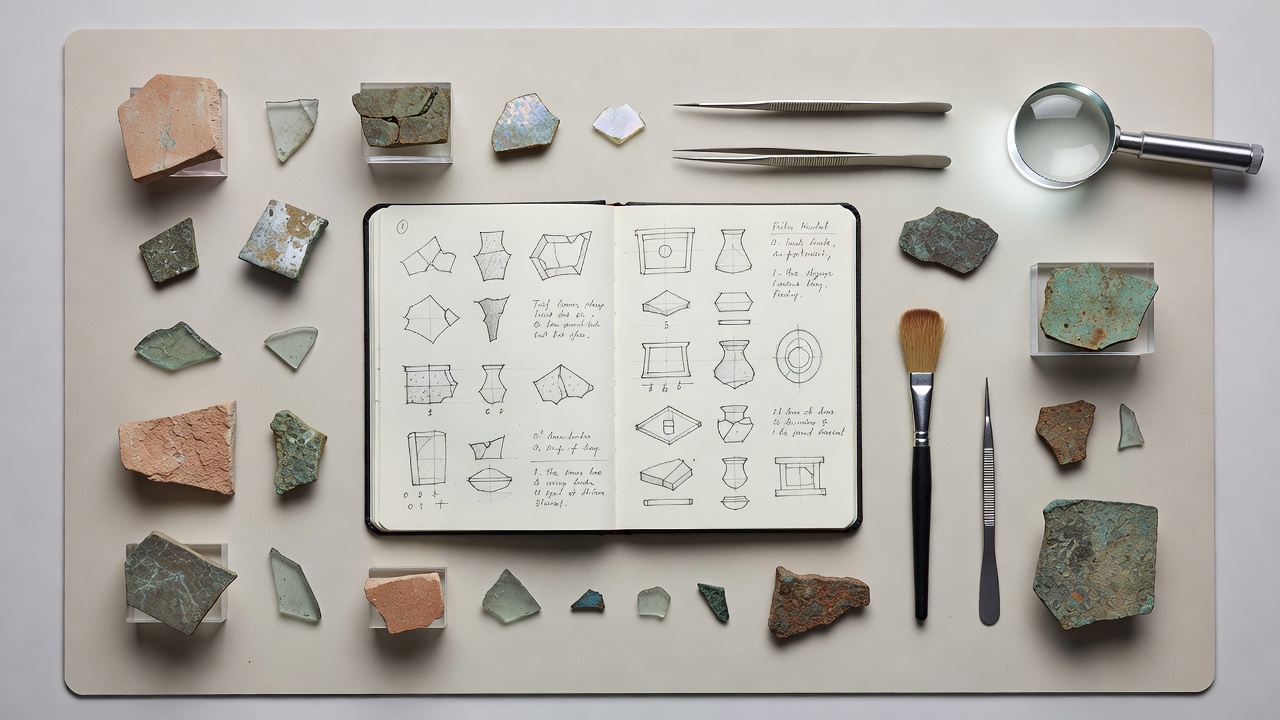
Record why, as well as what
A folder of finished models cannot explain why a specialist preferred one interpretation. Conservation documentation needs the question, the evidence considered, the choices made and the unresolved alternatives. This supporting account is sometimes called paradata: information about the reasoning behind a visualisation, rather than only metadata describing the files themselves.
Start with stable object and project identifiers. Link source photographs, scans, condition reports and comparison objects to those identifiers. Record who carried out each stage and what role they held. A modeller, a curator and a conservator may contribute different forms of expertise; a shared project credit should not obscure responsibility for particular decisions.
For AI-assisted work, identify the system, model version and relevant settings. Keep prompts, masks, constraints and available information about training data. If a hosted service changes without providing reproducible versions, document that limitation. A method can still be informative while remaining only partly reproducible, provided the record does not promise more than it supports.
Do not let presentation erase interpretation
Photorealism can make speculative detail appear authoritative. Public displays should distinguish surviving material from proposed additions in a way visitors can actually find. A small technical note several screens away is not enough when the primary image presents an apparently intact historical object. Put the essential distinction beside the reconstruction.
Layered views are useful: show the object as recorded, an annotated proposal, and a combined interpretation. Use labels and patterns as well as colour so the distinction survives monochrome reproduction and remains accessible to more readers. Captions should say what was reconstructed, which evidence supported it and where uncertainty remains substantial.
Never imply that a generated surface has revealed lost pigment, an inscription or an individual's appearance without independent evidence. The visualisation may be an educational hypothesis, but its precision can exceed its historical basis. The ethical task is not to ban interpretation; it is to prevent interpretation from borrowing the authority of a measurement.
Consider rights and communities before release
Ownership of an object, copyright in photographs and permission to publish a model are different questions. A museum's public catalogue does not automatically permit every kind of download, training use or commercial reproduction. Check item-level rights, contractual conditions and applicable law before reusing source material. Credit alone does not replace permission where permission is required.
Some objects also carry cultural obligations that a general licence does not settle. Human remains, sacred objects and community-restricted knowledge may require consultation and limits on access. A technically reproducible model can expose details or enable uses that the custodians of the object consider harmful. Engage relevant communities early rather than treating consultation as approval sought after publication.
The ICOM Code of Ethics offers an important professional reference, while local law and institutional policy provide additional requirements. The appropriate decision depends on context. Open access can support research and public learning, but openness is not an automatic justification for disclosing every object or every layer of information.
Preserve a record that can change
Digital work needs maintenance. Keep original captures, editable working files and documented exports in formats appropriate to the institution's preservation plan. Store checksums to help detect unintended changes, maintain backups and test that files can actually be restored. A proprietary project file alone is a fragile long-term record.
Use version identifiers so a revised proposal does not silently replace an older one cited in research. Describe why a reconstruction changed: a new fragment, improved calibration, a corrected comparison or a revised interpretation. A superseded model can remain valuable as evidence of the research process, even when it should no longer be presented as the preferred result.
Conceptual frameworks such as CIDOC CRM can help express relationships among objects, events, people and records. The FAIR principles encourage data to be findable, accessible, interoperable and reusable. Neither framework automatically guarantees ethical use or historical accuracy. They support good information practice when combined with appropriate judgement and governance.
Finally, remember that a digital reconstruction does not replace the original object or reverse its loss. Nor does a printed completion automatically meet the material requirements of conservation treatment. The durable achievement is a transparent record: one that allows future specialists and communities to challenge today's decisions without having to reconstruct the reasoning from scratch.
A minimal decision record
| Record | What it should explain |
|---|---|
| Sources | Object identifiers, captures, comparisons and permissions. |
| Process | Software, versions, parameters and geometry-changing operations. |
| Reasoning | Alternatives considered, reviewers and reasons for selection. |
| Limits | Unknown regions, access restrictions and unresolved questions. |
| Preservation | Version, file relationships, checksums and maintenance responsibility. |
Further reading
- ICOM Code of Ethics for Museums.
- CIDOC Conceptual Reference Model.
- FAIR Guiding Principles.
- ICCROM — conservation knowledge and capacity building.
- Digital Preservation Coalition — digital preservation resources.
Keep asking what the record supports
Return to the object, revisit the assumptions, and make room for a better explanation.
Explore the workbench questions