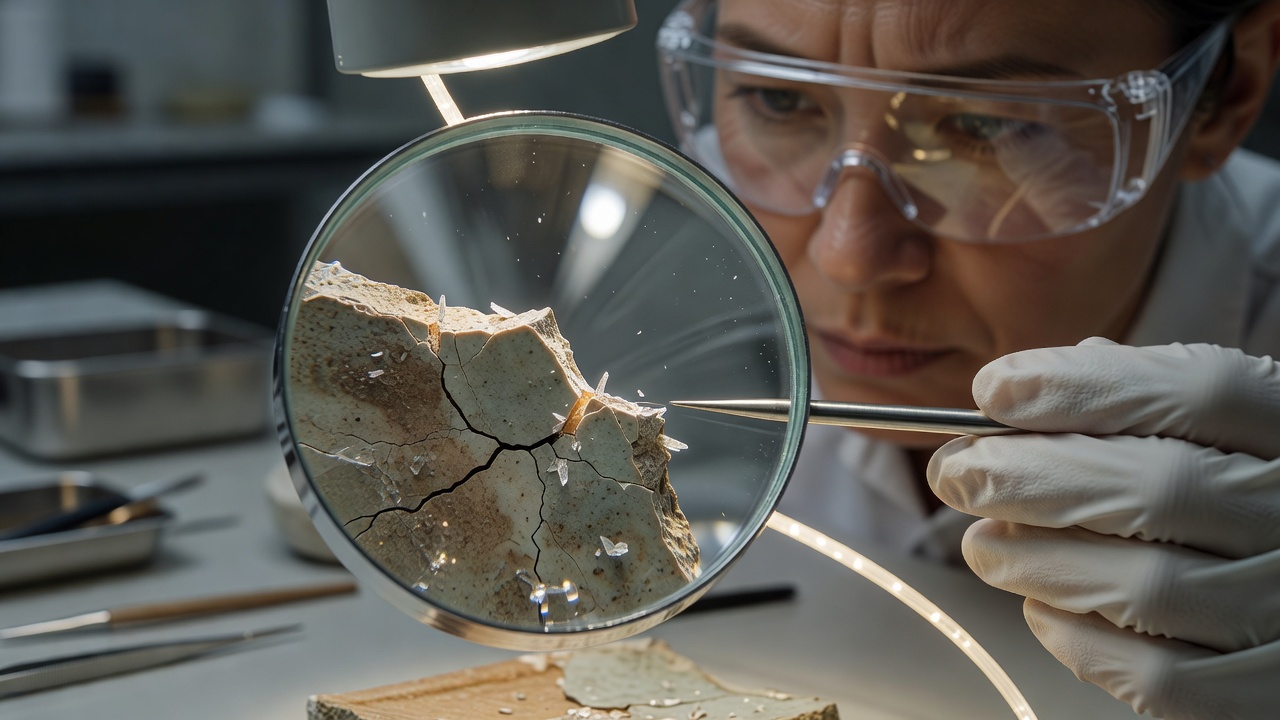
Decide what is being tested
Validation begins with a specific claim. Are two fragments likely to join? Does a proposed profile match surviving curvature? Is a display image a defensible explanation of one possible appearance? These are different questions. A reconstruction may be suitable for a clearly labelled educational diagram while remaining too uncertain to guide a physical fill.
Write the claim before choosing a metric. Otherwise it is easy to measure whatever the software reports and mistake that number for an answer. A low surface-distance error may describe an alignment well, but it does not establish archaeological association, original colour or the correctness of a missing ornament.
Also identify the consequence of being wrong. A reversible digital interpretation can be revised relatively easily. A treatment that affects fragile original material demands a different level of scrutiny. The same visual proposal should not automatically travel from a public touchscreen to a conservation workbench without a fresh decision about purpose and risk.
Check geometry without hiding the residuals
Start with scale, orientation and registration. If these are wrong, later comparisons may look systematically close or far apart for reasons unrelated to the hypothesis. Use independent measurements where possible, and record how reference points were chosen. Registration based on the very feature being tested can make a result seem stronger than it is.
Distance maps can show where measured and proposed surfaces disagree. Inspect the distribution of those differences, not just a single average. A large flat area may dominate a summary score and conceal a serious mismatch at the fracture edge. Report which regions were included, excluded or weighted differently.
Test physical plausibility as well. Do fragments intersect? Does wall thickness change without a material explanation? Does the join demand impossible deformation? Digital surfaces may overlap harmlessly on a screen while describing an impossible assembly. Contact, orientation and support all deserve review, even when the intended outcome remains entirely virtual.
Use evidence the model did not already see
An independent check is strongest when it adds information not used to construct the proposal. A withheld surface region, an archival photograph or a separate measurement can expose errors that fitting data will not. Simply comparing a model with its own training examples risks rewarding familiarity rather than historical correctness.
In research, deliberately masking part of a complete object's scan can help evaluate a completion method. The original surface then provides a known comparison. However, this artificial test does not reproduce every difficulty of real loss. Actual breakage may be uneven, eroded or accompanied by deformation, and the objects used for testing may not represent the collection of interest.
Historical context adds a different kind of constraint. Examine excavation records, documented provenance, manufacture, wear and appropriate comparison objects. A geometrically attractive profile may conflict with the object's likely date or workshop practice. Equally, a familiar museum category should not overrule unusual but well-documented physical evidence.
Describe uncertainty where it occurs
Confidence rarely belongs uniformly to an entire reconstruction. A matched fracture might be strongly supported while a rim extension remains tentative and decoration wholly unknown. Use region-based annotations or separate layers so readers can locate each claim. Do not rely on colour alone; labels, patterns and alternative views improve accessibility.
A model's internal score is not automatically the probability that a reconstruction is historically correct. Such an interpretation requires an appropriate evaluation and calibration process. If those are absent, describe the score in its actual role, such as similarity ranking, rather than presenting an unsupported percentage of certainty.
Invite review from people who can challenge different aspects of the result. A conservator may detect material inconsistencies, a curator may question a comparison, and a specialist in imaging may identify processing artefacts. Record disagreements and the evidence needed to resolve them. Consensus is useful, but documented reasoning is more durable than a list of approvals.
Finally, publish a conclusion that fits the tests. “Compatible with the surviving profile” is not the same as “the original form recovered.” A rejected candidate can still advance understanding by eliminating an attractive but unsupported option. Leaving a region unresolved is often the most accurate reconstruction available.
Compare claims, not just pictures
Further reading
- The Nara Document on Authenticity — context for evaluating heritage values and sources.
- ICOMOS — conservation principles and doctrinal texts.
- Smithsonian Open Access — collection resources; individual records still require critical assessment.
A result needs a record
Keep the tests, rejected alternatives and unresolved questions with the reconstruction.
Record the intervention