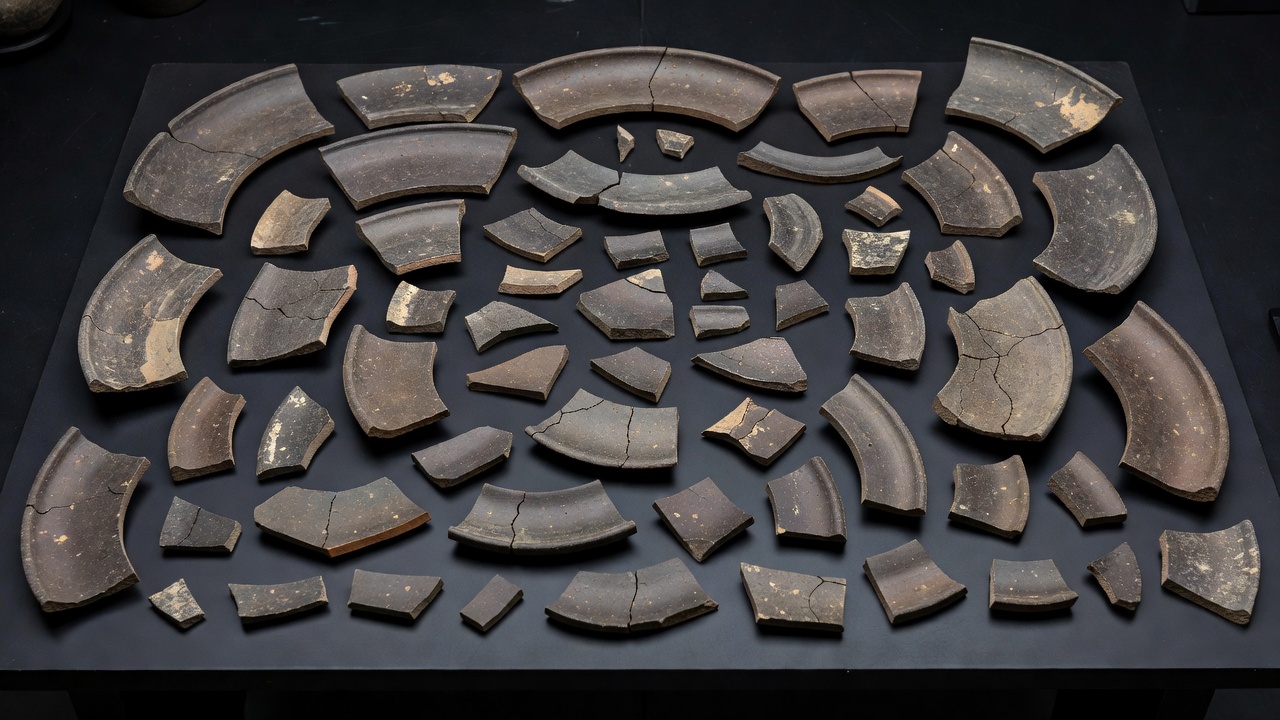
Separate assembly from completion
Digital reconstruction covers several different activities. Assembly attempts to place surviving pieces in relation to one another. Completion proposes material that is no longer present. Visualisation may add colour, lighting or a display setting. These activities can appear together in a single rendering, but they do not carry the same evidential weight.
Consider a broken vessel. Two fragments with complementary fracture surfaces might support a strong joining hypothesis. Extending their curvature to suggest a rim is a different claim. Painting a decorative band around that rim is another step again. A useful reconstruction preserves those boundaries instead of presenting one continuous surface as a single discovery.
Not every algorithm used here is AI. Rigid registration, geometric fitting and manual modelling may be more suitable than a learned model. The relevant question is whether a method supports the research task and exposes its assumptions, not whether it belongs to the newest software category.
Start with constrained proposals
Fragment-matching systems can compare local curvature, thickness, fracture texture and edge shape. Machine learning may help rank possible matches among many pieces. That ranking is a way to organise specialist attention, not permission to join objects physically. Similar surfaces may recur across unrelated objects, and erosion can remove the features most useful for comparison.
Symmetry offers another constraint. A surviving handle or repeated motif may provide a reference for a missing counterpart. Yet historical objects are not perfectly symmetrical by default. Hand manufacture, wear and later deformation can make mirroring misleading. Record whether symmetry was observed across surviving regions or merely assumed from a general object type.
Template-based methods use comparison objects or idealised shapes to propose a whole. They can help examine a likely form when much of an object is absent. The choice of template matters enormously: a vessel from another period or workshop may supply an attractive but historically unsuitable profile. Comparanda should be identified and justified, not hidden inside the modelling process.
Understand what a learned model supplies
A learned shape-completion model draws on patterns in its training examples. Given partial geometry, it may produce a complete shape that resembles those examples. This can be useful for generating alternatives quickly, especially where conventional modelling would be slow. It does not mean the model has access to the missing object's original state.
Training data can also narrow the answer without making that narrowing visible. A collection dominated by intact, symmetrical objects may encourage regular forms even when the damaged object was unusual. Modern replicas, inaccurate labels and incomplete provenance can influence results. If the dataset or model documentation is unavailable, that limitation should follow the proposal into publication.
Image inpainting fills missing pixels rather than missing physical material. It may suggest how a damaged painted surface could look, but an attractive image does not establish brushwork, pigment composition or hidden geometry. A two-dimensional completion may even describe a shape that cannot exist consistently in three dimensions. Use it for bounded exploration, not as a substitute for object-based analysis.
Keep alternatives alive
A responsible workflow saves more than the final polished candidate. Preserve the input record, the region allowed to change, model and software versions, parameters, prompts where relevant, and the basis for selecting one proposal over another. When practical, retain random seeds and multiple outputs. Reproducing a computational step may depend on the wider software environment as well.
Show alternatives that differ in meaningful ways. One might use only surviving geometry; another might incorporate a close comparison object. A third could leave the gap unresolved. If several proposals fit the same evidence, the result is underdetermined. Choosing the most elegant one does not remove that uncertainty.
Before moving towards physical treatment, separate the digital experiment from the treatment decision. A printed support, a removable fill and a virtual display each have different material, interpretive and care requirements. A conservator may find the digital proposal informative while deciding that no physical completion is justified.
The most useful result may therefore be a smaller claim: these fragments probably align; this rim profile remains possible; this decorative continuation lacks support. That is not a failure of digital reconstruction. It is a clearer account of what the object still permits us to know.
Scan → proposal → review
Further reading
- The London Charter — principles for computer-based visualisation of cultural heritage.
- CIPA Heritage Documentation — the relationship between documentation, measurement and heritage interpretation.
- Europeana — collection discovery; check each item's rights and provenance before reuse.
A plausible fit needs a test
Next, examine why a convincing rendering and a validated hypothesis are not the same thing.
Test the proposed whole